General safety instructions
Use the device only when it is in perfect technical condition and is installed, operated and maintained in accordance with this manual.
The contents of this document may be changed at any time without prior notice.
Danger from failure to follow the safety instructions!
This document contains important information on safe handling of the device. Potential hazards are highlighted. Failure to follow the instructions may result in serious injury, fire, electric shock, danger to life or damage to the device.
- Read this manual carefully.
- Follow the safety instructions.
- Keep the documents accessible.
- The operating instructions for this product are provided exclusively in digital form. If you need a printed version, you can request one from us at support@sonoro.de or +49 (0) 21 31 / 88 34 141.
Introduction
- The following document provides safety and operating information to help you use your product easily and safely.
- Please read the following safety instructions before using the device.
- Keep these safety instructions in a suitable place.
- If you pass on the device to another person, also provide these safety instructions.
- The manufacturer accepts no liability for damage resulting from failure to follow this manual.
For your safety
Intended use
The sonoro STREAMER is a network audio device for playing and routing audio signals to suitable audio devices, amplifiers, powered speakers or comparable audio components.
Intended use includes proper installation, initial setup and use of the device in accordance with all instructions in this manual.
The device is intended exclusively for stationary use at a fixed location in dry, clean indoor spaces with low dust levels.
Use is prohibited in particular:
- In high humidity or where condensation forms.
- In the presence of aggressive or corrosive gases, vapours or solvents.
- With large temperature fluctuations or direct sunlight.
- In environments containing oil mist, grinding dust or cutting dust.
- In atmospheres containing salt or chlorine.
- In areas with strong electromagnetic interference.
- In potentially explosive areas.
The permissible ambient temperature is +10 °C to +40 °C.
The manufacturer accepts no liability for damage resulting from use other than the intended use.
Use prohibited
- If the device or any of its components are damaged.
- After unauthorised modifications or alterations.
- After improper repairs.
- Under unsuitable ambient conditions.
Children and people with impaired abilities
- Do not leave the device unattended when children are nearby.
- People with reduced physical, sensory or mental abilities may use the device only under supervision.
- Packaging materials must not be used as toys. There is a risk of suffocation.
- Keep batteries and other small parts that can be swallowed out of the reach of children.
Electrical safety
The device runs on electricity, so there is always a risk of electric shock.
Always remove the power plug from the socket by holding the plug housing. Do not touch the plug’s metal contacts or live contacts on the device.
- Never touch the mains plug with wet hands.
- When removing the power plug from the mains socket, always pull directly on the plug. Never pull on the cable, as this could damage it.
- Ensure unobstructed access to the mains socket at all times so that the plug can be removed immediately in an emergency.
- Make sure that the power cable is not kinked, trapped or damaged.
- Route the power cable so that it does not create a trip hazard and cannot be reached by children.
- Disconnect the device completely from the mains if you will not be using it for a long time.
- Never open the device’s housing.
- Repairs must only be carried out by qualified personnel.
 Symbol for PROTECTION CLASS II, protection through double or reinforced insulation
 Power supply: alternating current only
Power supply
Only operate the device with the mains voltage specified on the rating plate.
- Operate the device only if the voltage indicated on the rating plate matches the voltage of your socket.
- An incorrect supply voltage may damage the device and pose a safety hazard.
- Only use an undamaged power cable suitable for the device.
- Do not use the device if the power cable, power plug or mains connection is damaged.
- We recommend using suitable surge protection.
- Disconnect the device from the mains during thunderstorms or when it will not be used for a prolonged period.
Audio, network and signal connections
The sonoro STREAMER has various digital and analogue audio connections as well as control and network connections.
Only use cables, plugs and connected devices that are intended and technically suitable for the respective connection.
- Where possible, switch off all audio devices involved before connecting or disconnecting cables.
- Before making or disconnecting audio connections, reduce the volume of connected amplifiers or powered speakers.
- Never force a plug into a connection.
- Do not use damaged cables, plugs or sockets.
- Ensure that connection cables are not kinked, crushed or routed over sharp edges.
- Route connection cables so that no tensile load is applied to the device’s connections.
- Keep all connections free from liquids, moisture and foreign objects.
- Where possible, route signal and network cables separately from power cables to avoid interference.
Analogue audio connections
The analogue audio connections include AUX IN, LINE OUT, PRE OUT and SUB OUT.
- Only connect suitable audio devices to the audio outputs.
- The audio outputs are not intended for connecting passive speakers directly.
- Passive speakers must be operated via a suitable external amplifier. To connect this amplifier, use only PRE OUT.
- CAUTION: The LINE OUT outputs the audio signal at a fixed output level. The device’s volume control does not change this level. This connection is intended exclusively for devices with their own volume control and for tape decks and recording devices with a suitable line input.
- Only use the LINE OUT, PRE OUT and SUB OUT outputs for their intended functions.
- Before connecting an amplifier, powered speaker or subwoofer, set a low volume on the connected device. When using PRE OUT, also reduce the STREAMER’s volume to avoid unexpectedly high playback volumes.
- Never connect audio outputs to speaker connections or mains voltage connections.
Digital audio connections
The device has digital audio connections, including OPTICAL IN, OPTICAL OUT and HDMI ARC.
- Only use cables suitable for the respective connection.
- Avoid sharp bends or tensile loads on optical cables.
- Avoid touching the optical contact surfaces of fibre-optic cables.
- Do not look directly into an active optical output.
- Use a suitable HDMI cable for HDMI ARC.
- Do not force HDMI plugs when inserting or removing them.
Network connection
- Only use suitable network cables for the network connection.
- Only connect the network connection to compatible network devices.
- Do not insert foreign objects into the network connection.
- Route network cables so that no tensile load is applied to the connection.
Trigger output
The TRIGGER OUT connection is used to control compatible external devices.
- Only connect devices suitable for use with the trigger output.
- Only use connection cables intended for this purpose.
- Never connect the trigger output to an audio input, speaker connection or mains voltage source.
Batteries

WARNING!
KEEP OUT OF REACH OF CHILDREN.
- Do not swallow the battery. Chemical burn hazard.
- Only use the battery type specified for the remote control.
- Always keep new and used batteries away from infants and children.
- If the battery compartment does not close securely, stop using the remote control.
- Seek medical attention immediately if you think a battery has been swallowed.
- Never attempt to recharge, open or heat non-rechargeable batteries.
- Do not damage or deform batteries.
- Remove the batteries if the remote control will not be used for a prolonged period.
- Follow the applicable regulations for battery disposal.
Placement, ventilation and overheating protection
Adequate air circulation around the device must be ensured for safe operation.
- Only place the device on a stable, level surface with sufficient load-bearing capacity.
- Protect the device from strong mechanical shocks.
- Allow sufficient space between the device and walls, furniture and other devices.
- Never cover any ventilation openings.
- Do not place the device directly next to radiators, storage heaters, stoves or other heat sources.
- Do not operate the device in enclosed or insufficiently ventilated furniture.
- Do not place objects filled with liquid on or immediately beside the device.
- The permissible ambient temperature is +10 °C to +40 °C.
Transport / shipping
- Improper transport or shipping may damage the device.
- Disconnect all cables from the device before transport.
- When travelling in a vehicle, stow the device so that it does not endanger anyone.
- If possible, pack the device in its original packaging.
- Protect the device from impacts, moisture and major temperature fluctuations during transport.
Disposal at the end of service life
 Do not dispose of with household waste
Devices marked with this symbol must not be disposed of with household waste but must be taken to a collection point for recycling electrical and electronic equipment.
Information on disposing of old devices is available from your local authority, local waste disposal service or specialist dealer.
Proper disposal helps protect the environment and health.
Batteries and rechargeable batteries may contain harmful substances and are subject to separate disposal regulations. Take batteries and rechargeable batteries to suitable collection points.
Restrictions in the 5 GHz and 6 GHz bands
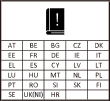

Under the radio regulations applicable to the device, the use of certain frequency ranges is subject to restrictions.
Frequency band: 5150–5250 MHz
For indoor use only.
Frequency band: 5250–5350 MHz
For indoor use only. Outdoor use is not permitted.
Frequency band: 5470–5725 MHz
Use in vehicles, trains, aircraft and unmanned aircraft systems is not permitted where prohibited by the regulatory requirements applicable to the device.
Frequency band: 5945–6425 MHz
Restricted to indoor use.