General safety instructions
Only use the device if it is in perfect technical condition and has been set up correctly. Any other use is considered improper. Intended use also includes reading and following this manual.
The contents of this document may be changed at any time without prior notice.
Danger from failure to follow the safety instructions!
This document contains important information on using the device safely. Particular attention is drawn to potential hazards. Failure to follow these instructions may result in serious injury or damage to the device.
- Read this manual carefully.
- Follow the safety instructions.
- Keep the documents accessible.
Introduction
- The following document provides safety and operating information to help you use your product easily and safely.
- Please read the following safety instructions before using the device.
- Keep these safety instructions in a suitable place. If you pass the device on to a third party, also provide these safety instructions.
- Failure to follow this manual may result in serious injury and damage to the device.
- We accept no liability for damage caused by failure to follow this manual.
For your safety
Symbols in this manual
Important safety information is specially marked. Always follow these instructions to prevent accidents and damage to the device.
Indicates a potentially hazardous situation that may cause damage to property or the environment.
The lightning symbol within an equilateral triangle alerts the user to uninsulated “dangerous voltage” inside the product that may be sufficient to pose a risk of electric shock to people.
The exclamation mark within an equilateral triangle alerts the user to important operating and maintenance instructions in the documentation supplied with the device.
Intended use
ATRON (SO-420) is an audio and radio device for private indoor use.
The device is suitable for the following purposes:
- Playing analogue and digital radio stations received via an aerial.
- Playing streaming services, radio stations and podcasts available over the internet.
- Playing audio via Bluetooth® from compatible devices.
- Playing content from media servers or streaming applications on the same network.
- Playing audio sources connected via compatible smart home or multiroom systems.
Any other use is considered improper and may cause damage to the device or safety risks.
Children and people with impaired abilities
- Do not leave the device unattended or use it when children or people who cannot assess the hazards are nearby.
- People (including children) who are unable to use the device safely due to their physical, sensory or mental abilities, or lack of experience or knowledge, must not use it without supervision or instructions from a responsible person.
- Always keep batteries out of the reach of children.
- Packaging materials must not be used as toys. There is a risk of suffocation.
Electrical safety
The device operates on electrical power, so there is a risk of electric shock. Pay particular attention to the following:
- Never touch the mains plug with wet hands.
- When unplugging from the mains socket, always pull directly on the plug. Never pull on the cable, as this could damage it.
- Ensure unobstructed access to the mains socket at all times so that the plug can be removed immediately in an emergency.
- Ensure that the power cable is not bent, trapped or run over.
- Disconnect the device completely from the mains if you will not be using it for a long time.
- Repairs must only be carried out by qualified personnel.
 Symbol for PROTECTION CLASS II, protection through double or reinforced insulation
 Power supply: alternating current only
 Power supply: DC only
Batteries
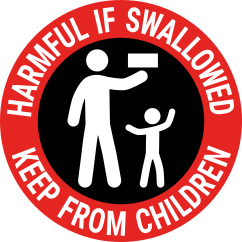
WARNING!
KEEP OUT OF REACH OF CHILDREN.
- Do not swallow the battery. Chemical burn hazard.
- A CR2032 battery is supplied for the remote control. If swallowed, a button cell battery can cause severe chemical burns and perforation of soft tissue within just two hours, resulting in serious injury and possibly death.
- Always keep new and used batteries away from infants and children.
- If the battery compartment does not close securely, stop using it and keep it away from infants and children.
- Seek medical attention immediately if you believe an infant or child has swallowed a button cell battery or inserted it into another body opening.
- Button cell batteries must be removed immediately by medical professionals to minimise the risk of serious injury or death.
- Do not try to recharge or open batteries. Risk of explosion!
- Do not damage or deform batteries.
- Never dispose of a battery in a fire or hot oven, or mechanically crush or cut it, as this can cause an explosion.
- Never leave a battery in environments with extremely high or low temperatures, which can cause an explosion or leakage of flammable liquids or gases.
- Never expose the rechargeable battery to extremely low air pressure, as this can cause an explosion or leakage of flammable liquids or gases.
- Only use batteries of the same or an equivalent type. Replacing the battery with an incorrect type can create hazards. Risk of explosion!
- Failure to follow these instructions may cause battery fluid to leak, which can irritate the skin. In case of contact:
- Rinse the fluid off with plenty of water.
- If fluid gets into your eyes, do not rub them. Rinse immediately with water for 10 minutes and seek medical attention without delay.
- Remove batteries/rechargeable batteries from the battery compartment as soon as they are depleted or if the device is unlikely to be used for a prolonged period.
- Follow environmental regulations when disposing of batteries.
USB-C service port
- The USB-C port is exclusively for servicing, such as software updates and diagnostic work by authorised personnel.
- The USB-C port is not intended for supplying power, charging external devices or transferring data by end users.
- Do not connect external devices for media playback, data transfer or charging.
Transport / shipping
- Improper transport/shipping may damage the surface of the device.
- When transporting the device in a vehicle, stow it so that it cannot endanger the occupants.
- If possible, pack the device in its original packaging.
Ambient conditions
Safe operation of the device requires suitable environmental conditions.
- Protect the device and remote control from moisture and high temperatures.
- Protect the device from liquids and splashing and dripping water.
- Never position the device close to sources of fire or heat.
- Always maintain sufficient clearance from walls and other objects.
Disposal at the end of service life
 Do not dispose of with household waste
Devices marked with this symbol must not be disposed of with household waste. They must be taken to a collection point for recycling electrical and electronic equipment. Information on disposing of old devices is available from your local authority, waste disposal service or the shop where you purchased the device. Proper disposal of old devices prevents environmental damage and protects your health.
Batteries/rechargeable batteries may contain toxic heavy metals and require special waste treatment. Take them to a municipal collection point or have them disposed of by a specialist company.
Restrictions in the 5 GHz & 6 GHz bands
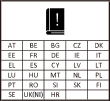

In accordance with Article 10 (10) of Directive 2014/53/EU, the packaging indicates that this radio equipment is subject to certain restrictions when placed on the market in Belgium (BE), Bulgaria (BG), Czech Republic (CZ), Denmark (DK), Germany (DE), Estonia (EE), Ireland (IE), Greece (EL), Spain (ES), France (FR), Croatia (HR), Italy (IT), Cyprus (CY), Latvia (LV), Lithuania (LT), Luxembourg (LU), Hungary (HU), Malta (MT), Netherlands (NL), Austria (AT), Poland (PL), Portugal (PT), Romania (RO), Slovenia (SI), Slovakia (SK), Finland (FI), Sweden (SE) and United Kingdom (UK).
Frequency band: 5150 – 5250 GHz:
Indoor use: Inside buildings only. Installation and use inside road vehicles and railway carriages are not permitted. Limited outdoor use: When used outdoors, devices must not be attached to a fixed installation, the exterior bodywork of road vehicles, fixed infrastructure or a fixed outdoor aerial. Use by unmanned aircraft systems (UAS) is restricted to the range 5170 - 5250 GHz.
Frequency band: 5250 – 5350 GHz:
Indoor use: Inside buildings only. Installation and use in road vehicles, trains and aircraft are not permitted. Outdoor use is not permitted.
Frequency band: 5470 – 5725 GHz:
Installation and use in road vehicles, trains and aircraft, and use for unmanned aircraft systems (UAS), are not permitted.
Frequency band: 5945 – 6425 GHz:
Restricted to indoor use, including trains with metal-coated windows and aircraft.