General safety instructions
Only use the device if it is in perfect technical condition and is installed, operated and maintained in accordance with the instructions in this manual.
The contents of this document may be changed at any time without prior notice.
Danger due to failure to observe the safety instructions!
This document contains important information for the safe use of the device. Particular attention is drawn to potential hazards. Failure to observe these instructions may result in serious injury, fire, electric shock, danger to life or damage to the device.
- Read these instructions carefully.
- Follow the safety instructions.
- Keep the documentation in an accessible place.
Introduction
- The following document provides safety and operating information to help you use your product easily and safely.
- Please read the following safety instructions before using the device.
- Keep these safety instructions in a suitable place.
- If you pass the device on to a third party, also pass on these safety instructions.
- Failure to observe these instructions may result in serious injury and damage to the device.
- The manufacturer accepts no liability for damage resulting from failure to observe these instructions.
For your safety
Intended use
The MEISTERSTÜCK 3 is an all-in-one audio system for playing audio content via the sources, connections and services supported by the device.
The device may only be used for private purposes. It is not suitable for commercial use and is intended solely for its intended purpose.
Use the device only as described in these instructions. Any other use not mentioned in these instructions is prohibited.
The manufacturer accepts no liability for damage resulting from improper use.
Children and persons with limited capabilities
- Do not leave the device unattended or use it when children or persons who are unable to assess the risks are nearby.
- Persons, including children, who are unable to use the device safely due to their physical, sensory or mental capabilities or due to lack of experience or knowledge must not use this device without supervision or instruction by a responsible person.
- Always keep batteries out of the reach of children. There is a risk of swallowing.
- If a battery has been swallowed or you suspect that a battery has been swallowed, seek medical attention immediately.
- Packaging materials must not be used for play. There is a risk of suffocation.
Electrical safety
The device is powered by electricity. There is therefore a general risk of electric shock.
- Never touch the mains plug with wet hands.
- When unplugging the mains plug from the socket, always pull directly on the plug. Never pull on the cable, as this may damage it.
- Ensure that the mains socket used is always freely accessible so that the mains plug can be disconnected immediately in an emergency.
- Make sure that the power cable is not kinked, pinched or run over.
- Route the power cable so that it does not create a tripping hazard and cannot be reached by children.
- Keep the device away from rain, moisture and heat sources.
- Only operate the device if the voltage specified on the rating plate of the device and mains plug matches the voltage of your power supply.
- An incorrect supply voltage can destroy the device.
- To avoid a risk of fire, disconnect the device completely from the mains if it will not be used for an extended period. To do so, unplug the mains plug from the socket.
- The plug-in power supply is used as the disconnect device and must remain readily accessible.
 Symbol for PROTECTION CLASS II, protection by double or reinforced insulation
 Power supply: alternating current only
 Direct current
Batteries
- One LR03/AAA battery is supplied for the remote control.
- Always keep new and used batteries away from infants and children.
- If the battery compartment does not close securely, stop using the remote control and keep it away from infants and children.
- Do not attempt to recharge or open batteries. There is a risk of explosion.
- Do not damage or deform batteries.
- Never dispose of batteries in a fire or hot oven.
- Do not crush or cut batteries, as this may cause an explosion.
- Never leave batteries in environments with extremely high or low temperatures. This may cause an explosion or leakage of flammable liquids or gases.
- Never expose batteries to extremely low air pressure. This may cause an explosion or leakage of flammable liquids or gases.
- Only use batteries of the same or an equivalent type.
- Replacing the battery with an incorrect type may cause hazards. There is a risk of explosion.
- Remove batteries from the battery compartment as soon as they are discharged or if the remote control is not expected to be used for an extended period.
- Observe the applicable environmental regulations when disposing of batteries.
Laser and CD drive
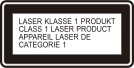
This device is classified as a Class 1 laser product. Laser radiation can damage the eyes.
- Do not attempt to disassemble the device or open the CD drive.
- Have maintenance and repair work carried out only by the manufacturer, its customer service department or appropriately qualified personnel.
- Do not insert any objects into the CD slot other than CDs approved for the device. Unsuitable media or foreign objects may damage the device.
- Do not use mini CDs or MD CDs with a diameter of 8 cm.


Headphones
 Avoid excessively high volume levels.
- Always reduce the device volume before putting on the headphones.
- Only increase the volume to the desired level once the headphones are correctly positioned.
- Do not set the volume too high when listening with headphones.
- If you experience a persistent noise or background sound in your ears, such as ringing, reduce the volume or stop using the headphones.
- Never set the volume so high that you can no longer perceive your surroundings.
USB charging port
- Only charge external devices in a dry environment.
- Only charge external devices using suitable accessories.
- Connections to the USB port must be limited to USB version 2.0 or higher.
- Connection to so-called Power USB ports is not permitted.
Defects and repairs
- If the device is defective, do not attempt to repair it yourself.
- If the mains plug, power supply or power cable is damaged, it must be replaced by the manufacturer, its customer service department or appropriately qualified personnel.
- If liquid has entered the device, the device has been dropped or otherwise damaged, it must be inspected by qualified personnel.
- Disconnect a damaged device from the mains and contact customer service or an authorised specialist dealer.
Environmental conditions
Safe operation of the device requires suitable environmental conditions. The device is intended for use in temperate climates.
Weather, moisture and temperatures
- Protect the device and remote control from weather, moisture and high temperatures.
- Do not use the device outdoors or place it in areas exposed to strong sunlight.
- Protect the device from liquids, splashing and dripping water.
- Do not place containers filled with liquid, such as vases, next to or on the device.
Installation location
- Do not use the device in areas with high humidity.
- Protect the device from heavy contamination, such as grease splashes and unfiltered kitchen exhaust air.
- Never place the device in the immediate vicinity of fire or heat sources, such as burning candles, hotplates or heaters.
Installation surface
- Protect the device from strong mechanical shocks and place it on a stable surface.
- Do not place the device on soft surfaces, as this may block the ventilation openings.
- The rubber feet of the device may leave marks on certain surfaces. Therefore, use a suitable protective mat.
Ventilation
- Position the device so that sufficient airflow is ensured to prevent heat build-up inside the device.
- Always maintain a minimum distance of 10 cm from other objects or walls.
Subwoofer
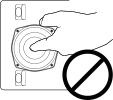
Do not touch or press the subwoofer on the underside of the device. This may damage the speaker.
Transport / shipping
Improper transport or shipping may damage the surface of the device or media inside it and may cause malfunctions.
Personal safety
- Secure the device in a vehicle during travel so that it does not endanger the occupants.
Preventing damage to the device
- The front, edges and corners of the device are sensitive to pressure. Protect these areas from excessive loads.
- Do not tilt the device over its corners or edges.
- Do not place the device upside down.
- When transporting or shipping the device, use the original packaging whenever possible.
- Keep the original packaging for future transport.
- If you no longer have the original packaging, use a suitable box of sufficient size and protect the device with appropriate packaging material.
Protecting media inside the device
- To prevent damage to inserted media, remove it from the device before transport or shipping.
Disposal at the end of service life
 Do not dispose of with household waste
Devices marked with this symbol must not be disposed of with household waste. They must be taken to a collection point for recycling electrical and electronic equipment.
Information on disposing of old devices is available from your local authority, local waste disposal company or the retailer from whom you purchased this device.
By disposing of old devices correctly, you help prevent harm to the environment and human health.
Batteries and rechargeable batteries may contain toxic heavy metals and are subject to hazardous-waste disposal requirements. Take batteries and rechargeable batteries to a municipal collection point or have them disposed of by a specialist company.
Restrictions in the 5 GHz & 6 GHz bands
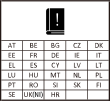

In accordance with Article 10(10) of Directive 2014/53/EU, the packaging indicates that this radio equipment is subject to certain restrictions when placed on the market in the countries concerned.
Frequency band: 5150 – 5250 MHz
Indoor use: inside buildings only. Installation and use inside road vehicles and railway carriages are not permitted. For limited outdoor use, devices must not be attached to a fixed installation, the exterior body of road vehicles, fixed infrastructure or a fixed outdoor antenna. Use by unmanned aircraft systems (UAS) is restricted to the 5170 – 5250 MHz range.
Frequency band: 5250 – 5350 MHz
Indoor use: inside buildings only. Installation and use in road vehicles, trains and aircraft are not permitted. Outdoor use is not permitted.
Frequency band: 5470 – 5725 MHz
Installation and use in road vehicles, trains and aircraft, as well as use for unmanned aircraft systems (UAS), are not permitted.
Frequency band: 5945 – 6425 MHz
Restricted to indoor use.